
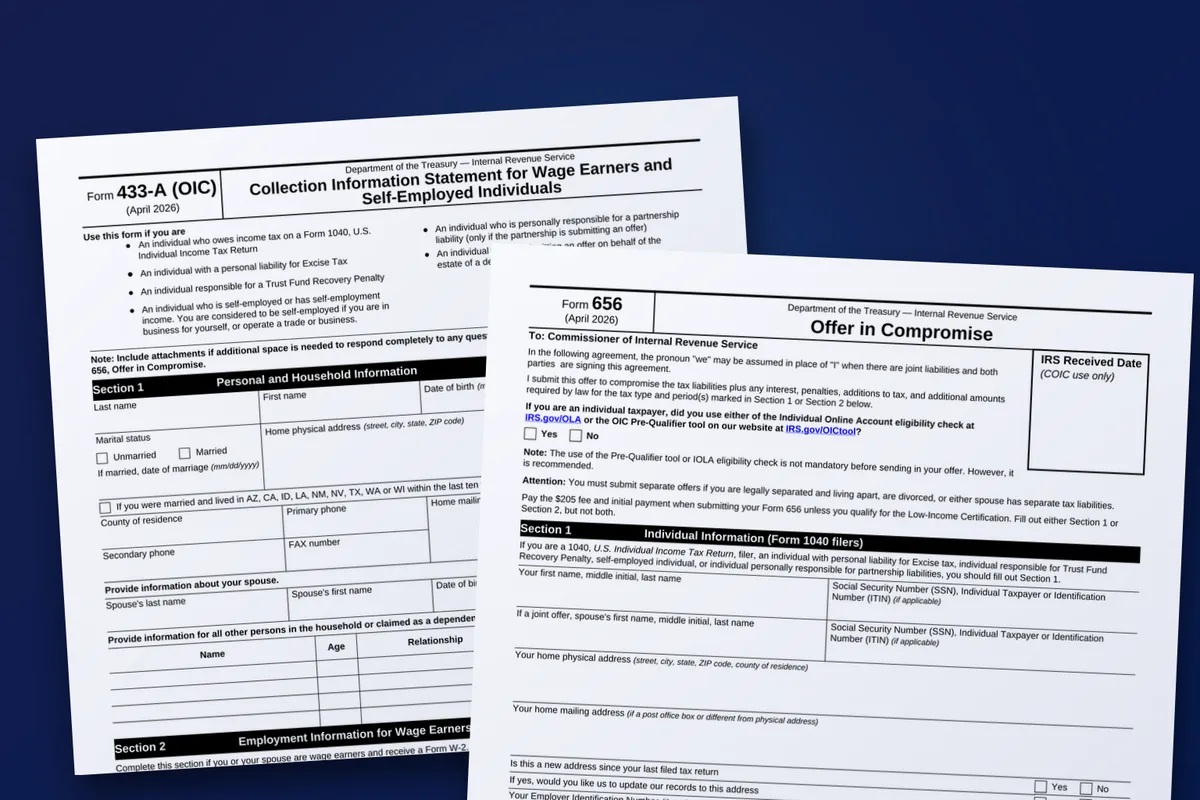
What is an Offer in Compromise?
An Offer in Compromise (OIC) is an IRS program for qualifying taxpayers who cannot realistically pay their full federal tax balance. The IRS accepts an offer when it represents the most they can reasonably expect to collect within a reasonable period. It is an official IRS program with strict eligibility rules.
The program exists because the IRS would rather collect a realistic amount now than chase a balance for ten years and recover little. But acceptance is not automatic, and it is not the right tool for every taxpayer. The IRS examines your finances closely and applies a defined formula before it accepts an offer.
Be wary of any ad that promises a specific result. The IRS accepts some offers and rejects many others. What matters is whether your specific financial situation fits the IRS's criteria.
Who does an Offer in Compromise realistically help?
An OIC realistically helps taxpayers whose income, assets, and reasonable monthly expenses leave them unable to pay their full IRS balance before the collection period ends. If you can pay in full through an Installment Agreement or by liquidating assets, the IRS will expect you to do that instead.
In practice, good OIC candidates tend to share several traits:
- A meaningful tax balance, often several thousand dollars or more, that they cannot pay in full within the remaining collection window.
- Limited equity in assets (home, vehicles, retirement accounts, business interests).
- Income that, after allowable living expenses, leaves little or no monthly disposable income.
- All required tax returns filed and current-year tax obligations being met (estimated payments or withholding).
- No open bankruptcy case.
If your situation is temporary (a bad year, but recovery is likely), the IRS may view an OIC as premature and instead suggest a payment plan or Currently Not Collectible status. A tax professional can help you weigh which option fits your facts.
How does the IRS evaluate an offer?
The IRS evaluates an offer using a calculation called Reasonable Collection Potential (RCP). RCP is the sum of the net realizable value of your assets plus a multiple of your monthly disposable income. The IRS generally accepts an offer when the amount represents the most it can expect to collect within a reasonable period, and the RCP is how it estimates that amount.
Breaking that down:
- Net realizable value of assets. The IRS looks at the quick-sale value of what you own (typically around 80% of fair market value) minus any secured debt against it. This includes real estate equity, vehicles beyond a modest exemption, bank balances, investments, and certain retirement accounts.
- Future income component. The IRS takes your monthly income, subtracts allowable living expenses based on national and local standards, and multiplies the remainder. The multiplier is 12 months for a lump-sum offer paid within five months of acceptance, or 24 months for a periodic payment offer.
- Allowable expenses. The IRS uses Collection Financial Standards for food, housing, transportation, and healthcare. These are not what you actually spend. They are capped figures, which is why the calculation often surprises people.
There are three legal grounds for an offer: doubt as to collectibility (the most common), doubt as to liability (you don't actually owe it), and effective tax administration (paying in full would create economic hardship or be unfair given exceptional circumstances).
What does the OIC process look like?
The process starts with filing Form 656 and Form 433-A (OIC) or 433-B (OIC) for businesses, along with documentation of income, expenses, and assets. You also submit a $205 application fee and an initial payment, both of which are waived for taxpayers who meet the low-income certification.
From there, expect the following stages:
- Intake and assignment. The IRS confirms you're eligible to apply (returns filed, not in bankruptcy) and assigns the case to an offer examiner. This can take several months.
- Review. The examiner verifies every figure on your 433-A. They may request bank statements, pay stubs, vehicle valuations, and property records. Expect questions.
- Decision. The IRS accepts, rejects, or returns the offer. A rejection can be appealed within 30 days. A return means a defect, such as missing forms, unfiled returns, or a missed payment, and is not appealable.
- Compliance period. If accepted, you must file and pay all taxes on time for the next five years. Slipping during that window can default the agreement and reinstate the original balance.
In our experience, most clients' cases take about 5 to 12 months from start to finish, depending on the situation and the steps involved, though no timeline is guaranteed. By law the IRS has two years from receiving an offer to accept or reject it, not counting time in appeals, and an offer it has not decided by then is automatically approved. While the offer is pending, the collection statute is paused, and most enforcement actions stop.
Before anyone fills out a single form, it is worth knowing whether your numbers point toward an OIC at all.
Think an Offer in Compromise might fit your situation? Allies Tax Services can review the eligibility factors with you. Use Get Started on this page or give us a call.
What does an Offer in Compromise cost?
Beyond the $205 application fee and required initial payment, the main cost is the offer amount itself and, for most people, professional representation. Cases with business income, significant assets, or prior rejections especially benefit from experienced help.
Professional fees vary widely based on case complexity. A straightforward wage-earner OIC is very different from a self-employed taxpayer with depreciated business assets and irregular income. Be cautious of firms that quote a flat fee before reviewing your transcripts or financial picture. That's often a sign the analysis hasn't actually been done.
What happens if your offer is rejected?
A rejected offer is not the end of the road. You have 30 days to appeal through the IRS Independent Office of Appeals, where an independent officer reviews the calculation. An appeals officer can accept a revised offer. You can also submit a new offer if your circumstances change, or pivot to an Installment Agreement or Currently Not Collectible status.
What you should not do is ignore the rejection letter. Once the offer is closed, collection activity can resume, and the collection clock starts running again.
How Allies Tax Services helps
An Offer in Compromise only works when the numbers support it, so that is where we start. A licensed professional on our team reviews your IRS account, income, expenses, and assets the way the IRS will, and tells you plainly whether an offer is realistic. If it is, we:
- Get any missing returns filed first, since the IRS will not consider an offer while returns are outstanding.
- Prepare Form 656 and Form 433-A (OIC) or 433-B (OIC) with the documentation the offer examiner will ask for.
- Handle the IRS's questions during the review, and the appeal if an offer is rejected.
If an offer is not the right fit, we look at the other IRS options you may qualify for, such as an Installment Agreement or Currently Not Collectible status. Every case is different, but most of our clients' cases take about 5 to 12 months from start to finish.
Frequently asked questions
How much will the IRS actually accept?
There is no fixed percentage. The IRS accepts an amount equal to your Reasonable Collection Potential, essentially your asset equity plus future disposable income over 12 or 24 months. It depends entirely on your finances and can be close to the full balance.
How long does an Offer in Compromise take?
In our experience, most clients' cases take about 5 to 12 months from start to finish, depending on the situation, though no timeline is guaranteed. The IRS has two years from receiving your offer to accept or reject it, not counting time in appeals. While your offer is under review, the IRS generally pauses active collection, and the 10-year collection statute is suspended for the time the offer is pending plus 30 days.
Can I get an Offer in Compromise if I have unfiled tax returns?
No. The IRS will return your offer without considering it if any required returns are unfiled. Getting current on filing is a prerequisite, which is why many OIC cases start with back-tax return preparation before the offer itself is submitted.
Will an Offer in Compromise hurt my credit?
The IRS does not report to credit bureaus. However, if a Notice of Federal Tax Lien has been filed against you, that public record can affect credit. A lien is typically not released until the accepted offer is fully paid, but it is released afterward.
What happens if I default after my offer is accepted?
If you fail to file or pay any federal tax during the five-year compliance period, the IRS can default the agreement. The original balance, minus payments made, is reinstated, plus penalties and interest that accrued. Staying compliant after acceptance is essential.
Is an Offer in Compromise better than an Installment Agreement?
Neither is universally better. An OIC suits taxpayers who genuinely cannot pay in full; an Installment Agreement suits taxpayers who can pay over time. The right choice depends on your income, assets, and how much of what you owe you can realistically pay off before the collection statute expires. Allies Tax Services can model both with your numbers.
A realistic next step
An Offer in Compromise can make a real difference for the right taxpayer and cost months for the wrong one. The difference is whether your finances actually fit the IRS's formula. If you're not sure where you stand, talk with our team before anyone prepares a single form.