
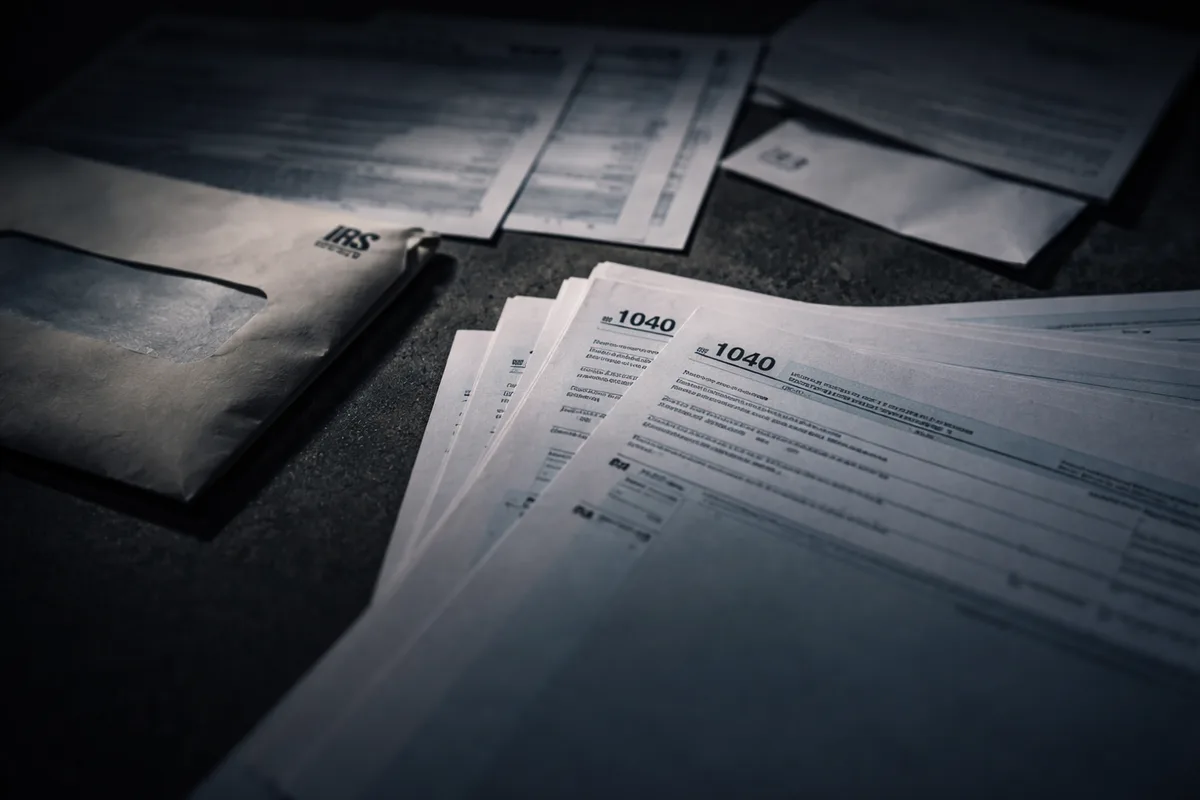
What happens if you don't file your tax return?
If you don't file, the IRS eventually files a version of the return for you called a Substitute for Return. It uses only the income reported to the IRS and gives you almost no deductions, so the balance is usually inflated. Penalties and interest then build on that inflated number until the account moves into collections.
That is the short version. The longer version matters, because the difference between filing late and never filing at all is often tens of thousands of dollars. Not filing is common, and it is rarely about defiance. People miss a year during a divorce, a business failure, an illness, or a stretch where they knew they owed and could not pay. Then one missed year turns into three, and opening the mail starts to feel worse than ignoring it.
The good news is that unfiled returns are one of the most fixable tax problems there is. But almost every resolution option, including an Installment Agreement, Currently Not Collectible status, and an Offer in Compromise, requires you to be current on your filings first. Filing is the door. Nothing else opens until you walk through it.
What is a Substitute for Return, and why is it worse than filing yourself?
A Substitute for Return, or SFR, is a return the IRS prepares on your behalf when you don't file. The IRS uses W-2s, 1099s, and other third-party data it already has. It does not include your business expenses, cost basis on stock sales, dependents, itemized deductions, or most credits. The resulting balance is almost always higher than reality.
A few specifics that explain why the number comes back so large:
- The IRS typically assigns the least favorable filing status available, often single or married filing separately, along with the standard deduction only.
- Self-employed taxpayers get taxed on gross receipts from Form 1099-NEC and Form 1099-K with no offsetting expenses, so a contractor who netted very little can be assessed on the full gross amount.
- Stock and real estate sales reported on Form 1099-B show proceeds with no cost basis, so a break-even sale can look like a full gain.
- Credits you would have qualified for, including education and child-related credits, are simply left off.
The important thing to understand is that an SFR is not the final word. In most cases you can still file your own original return for that year, and the IRS will adjust the account to your figures if the return is accurate and properly documented. In practice, this single step often reduces a balance more than any negotiation would.
How large do failure-to-file penalties get?
The failure-to-file penalty is 5% of the unpaid tax per month or part of a month, capped at 25%. It reaches that cap in five months. The separate failure-to-pay penalty runs at 0.5% per month, also capped at 25%. Interest compounds daily on tax and penalties alike.
When both penalties apply in the same month, the failure-to-file penalty is reduced to 4.5% so the combined rate is 5% per month. That still means a quarter of your tax bill can be added in penalties before the first summer is over. There is also a minimum penalty for any return filed more than 60 days late, recently set at $510 and adjusted annually, or 100% of the tax due, whichever is smaller.
Notice the ratio: the penalty for not filing is ten times the penalty for not paying. If you owe and cannot pay, filing on time and paying nothing is dramatically cheaper than doing neither. That is one of the most useful facts in this entire article.
What notices does the IRS send about unfiled returns?
The IRS usually warns you in stages. Early notices ask for the missing return. Later notices propose a tax amount and give you a deadline to respond. If you don't answer, the proposed amount becomes a legal assessment and the account moves into standard collections, with levy and lien authority attached.
The sequence commonly looks like this:
- CP59 or CP80: the IRS has no record of a return for a specific year.
- LT16 or LT18: a request for the unfiled returns, often from the collections side.
- CP63: your refund is being held because of an unfiled year.
- CP2566: the IRS has calculated a proposed assessment for you.
- CP3219N: the Statutory Notice of Deficiency, giving you 90 days to file a Tax Court petition or resolve it.
- CP14, then reminders, then CP504 and a Final Notice of Intent to Levy once the balance is assessed.
The 90-day letter is the pivot point. Before it expires you have the widest set of options. After it expires the tax is assessed, and the conversation shifts from what you owe to how you are going to pay it.
How does the problem compound the longer it sits?
It compounds in four directions at once: the penalty percentages climb toward their caps, interest accrues daily on a growing balance, refunds you were owed expire permanently, and the IRS gains enforcement powers it did not have before. Waiting almost never improves the position.
The refund point surprises people. You generally have three years from the original due date to claim a refund. Miss that window and the money is gone, even if the IRS owes you. We commonly see taxpayers with several unfiled years where some years would have produced refunds and others produced balances. Filing late can mean forfeiting the refunds while still owing the balances in full.
There is also a timing issue that cuts both ways. The IRS normally has three years from the date a return is filed to assess additional tax, but that clock never starts if no return is filed. An unfiled year stays open indefinitely. Meanwhile the ten-year collection period does not begin until tax is assessed, so an SFR assessment can push collection activity on a decade-old year well into the future.
Can you go to jail for not filing?
Criminal prosecution for failure to file is possible under the law but rare, and it is reserved for willful conduct, usually involving significant income, repeated years, and evidence of concealment. The overwhelming majority of unfiled-return cases are handled as civil matters: penalties, interest, and collection activity.
We say this not to dismiss the concern but to right-size it. Fear of prosecution is one of the main reasons people avoid filing, and avoidance is exactly what makes a case look worse. Voluntarily coming forward and filing correct returns is the single strongest fact you can put in your own file. If your situation involves large amounts of unreported income or multiple years of deliberate nonfiling, talk to a tax attorney before you file anything.
How many years of back returns do you actually have to file?
In most cases the IRS asks for the last six years of returns to consider you compliant. That is longstanding IRS policy, not a statute, and a revenue officer can request more or accept fewer depending on the facts. You should confirm the specific years before you spend money preparing returns.
The practical starting point is pulling your IRS account and wage and income transcripts. Those transcripts show which years the IRS is actually missing, which years already have an SFR posted, and what income was reported to the IRS under your Social Security number. Reconstructing returns without them is guesswork.
If your records are gone, that is a normal problem, not a disqualifying one. Transcripts, bank statements, and reasonable reconstruction of business expenses are accepted approaches. What matters is that the return you file is accurate and supportable.
How do you fix unfiled returns and get back on track?
The path is consistent: pull transcripts, confirm the missing years, prepare and file accurate returns, correct any Substitute for Return assessments, then choose a resolution option for whatever balance remains. Doing these in order matters, because the IRS will not approve most agreements while returns are outstanding.
Once your filings are current, the realistic options include:
- An Installment Agreement, requested on Form 9465 or online, to pay the balance over time.
- Currently Not Collectible status, which pauses active collection when your income barely covers necessary living expenses.
- An Offer in Compromise, submitted on Form 656, which settles the debt for less than the full amount when your income, assets, and expenses support it.
- First-Time Penalty Abatement or reasonable cause relief to remove some of the failure-to-file and failure-to-pay penalties.
No one can promise a particular outcome, and the right option depends entirely on your numbers. But the first step is the same for everyone, and it is entirely within your control: get the returns filed. If the years involve business income, missing records, an existing SFR assessment, or an active levy threat, this is the point to bring in a licensed professional rather than working it out alone.
Frequently asked questions
What happens if I didn't file taxes for 5 years?
The IRS may have filed Substitute for Returns for some of those years, creating inflated balances with penalties and interest. Years with no SFR remain open indefinitely. The fix is to pull transcripts, file accurate original returns for each year, and then address the remaining balance through a resolution option.
Will the IRS file my tax return for me?
Sometimes, through a Substitute for Return. It uses only third-party income data and excludes your deductions, credits, and business expenses, so the balance is usually much higher than what you would actually owe. You can generally still file your own original return to correct it.
Can I still get a refund on an old unfiled return?
Only within three years of the original due date. After that window closes, the refund is permanently forfeited even though you were entitled to it. This is one of the strongest reasons not to delay filing older years.
Is it better to file late than not to file at all?
Yes. The failure-to-file penalty is 5% per month up to 25%, while the failure-to-pay penalty is 0.5% per month. Filing without payment costs far less than filing nothing, and filing is required before the IRS will approve most resolution options.
Can penalties for not filing be removed?
Sometimes. First-Time Penalty Abatement may apply if you had a clean compliance history for the prior three years, and reasonable cause relief may apply for circumstances such as serious illness, natural disaster, or records destroyed beyond your control. Relief is never guaranteed and depends on documentation.
What if I file and then can't pay what I owe?
File anyway, then choose a payment path. An Installment Agreement spreads the balance over time, Currently Not Collectible status can pause collection if you cannot meet basic living expenses, and an Offer in Compromise may settle the debt for less when your financial situation supports it.