

What is an IRS Installment Agreement?
An Installment Agreement is a formal arrangement with the IRS to pay your balance in monthly payments instead of all at once. Once the agreement is in place and you keep up with it, the IRS generally stops active collection action such as wage levies and bank levies while payments continue.
Most people who owe the IRS cannot write one check for the full amount. That is normal, and the IRS expects it. An Installment Agreement is the most common resolution we handle, and for many taxpayers it is the practical answer: it turns an alarming lump sum into a monthly number you can plan around.
It is not a reduction of what you owe. Penalties and interest keep accruing on the remaining balance until it is paid, although the failure to pay penalty rate drops while an approved agreement is in effect. The trade is predictability and protection from enforcement, not a smaller total.
What types of IRS payment plans are there?
The IRS offers short-term payment plans of up to 180 days and long-term Installment Agreements paid monthly. Long-term plans divide into guaranteed, streamlined, non-streamlined and partial pay agreements. Which one fits depends on how much you owe, how fast you can pay it, and whether the IRS requires a financial statement.
- Short-term payment plan. Up to 180 days to pay in full. Generally available to individuals who owe less than $100,000 in combined tax, penalties and interest, according to the IRS payment plans page. There is no setup fee, but penalties and interest continue.
- Guaranteed Installment Agreement. For smaller individual balances when filing and payment history is clean. The IRS must accept it if the statutory conditions are met.
- Streamlined Installment Agreement. The workhorse. Individuals who owe $50,000 or less in combined tax, penalties and interest can generally qualify for a long-term monthly plan without submitting a full financial statement. Businesses that owe $25,000 or less in payroll taxes have a parallel route.
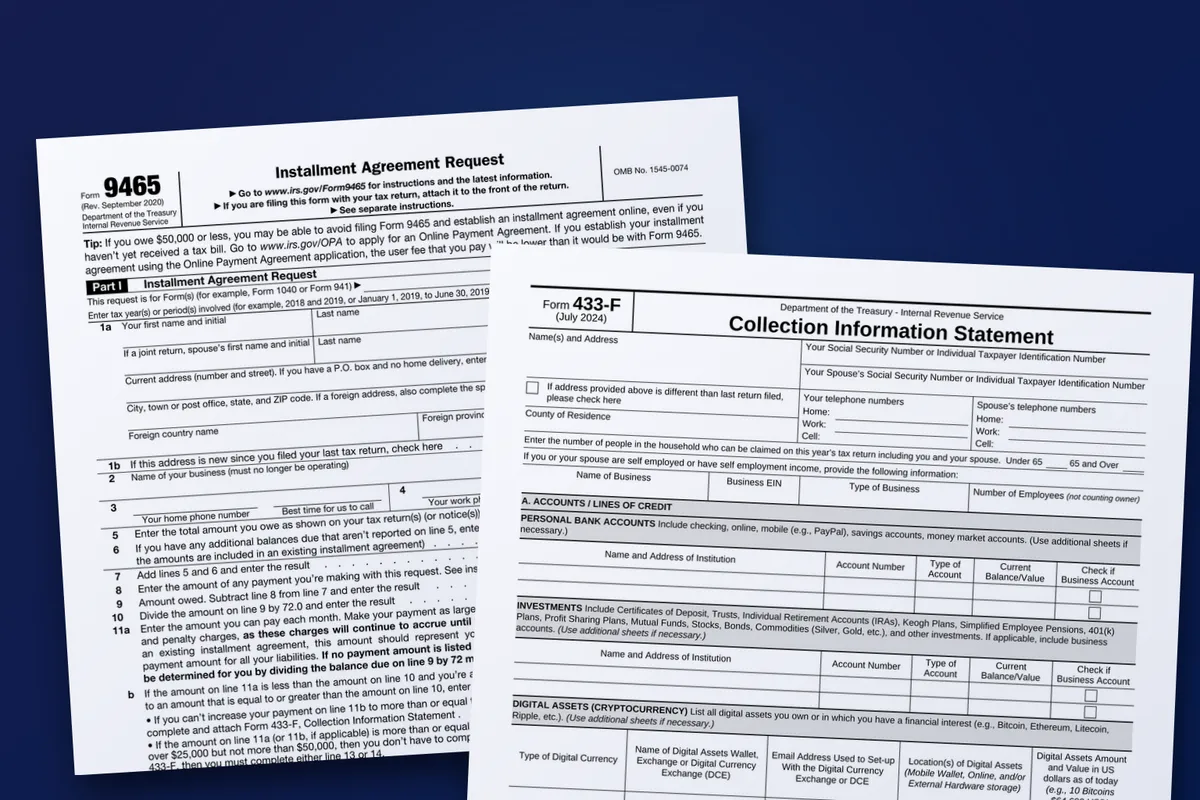
- Non-streamlined Installment Agreement. For balances above the streamlined thresholds. The IRS requires a Collection Information Statement and supporting documents before it will approve a monthly amount.
- Partial Pay Installment Agreement. A monthly plan based on what you can actually afford, where the payments are not expected to cover the full balance before the collection period expires. This requires a full financial review by the IRS.
Who qualifies for an IRS Installment Agreement?
To qualify, you generally need to be current on your filing obligations and able to show the IRS a monthly payment you can sustain. Taxpayers within the streamlined dollar limits usually qualify on the balance alone. Larger balances require a financial statement with documentation behind every figure.
The filing requirement trips up more people than the money does. The IRS will not approve a plan while returns are missing. If you have unfiled years, those returns have to be prepared and filed first, which is why back-tax cases and payment plan cases are usually the same case.
In practice, a large share of the people we sign are self-employed or paid on a Form 1099: truck drivers, construction workers and cleaning crews are among the most common. We commonly hear that they did not realize nothing was being withheld from their pay, so a balance only appeared when they filed, or it kept growing while filing was put off. Most had not been making estimated payments. Getting current on estimated taxes is part of qualifying, because the IRS will not set up a plan for old years while a new balance is building.
If a small LLC or corporation is involved, the paperwork is usually what slows things down: the business EIN, bank statements, and an income and expense summary for each unfiled year. Cases move noticeably faster when those are gathered at the start rather than piece by piece.
What does an Installment Agreement cost?
The IRS charges a user fee to set up a long-term Installment Agreement. The amount depends on how you apply and whether you authorize direct debit from a bank account, and reduced or waived fees exist for low income taxpayers. Short-term plans carry no setup fee. Current fee amounts are listed on the IRS payment plans page.
The bigger cost is time. Interest continues on the unpaid balance for as long as it exists. The failure to pay penalty also continues, though the rate is cut in half, from 0.5% to 0.25% of the unpaid tax per month, while an approved Installment Agreement is in effect for an individual who filed on time.
Direct debit agreements are worth considering for a second reason: they fail less often. Missed payments are the main way a plan falls apart, and an automatic draft removes that risk.
What does the IRS want to see for larger balances?
Above the streamlined limits, the IRS decides your monthly payment from a financial statement: Form 433-F or Form 433-A. It compares your income to allowable living expenses and treats the difference as what you can pay each month. Every figure needs a document behind it.
In our experience, the full set the IRS expects includes recent bank statements and pay stubs, the lease or mortgage statement, car loan and insurance statements, and statements for any retirement or investment accounts. Submitting the statement with the documentation already assembled is what keeps the request from bouncing back with questions and restarting the clock.
Allowable expenses are not the same as your actual budget. The IRS applies standard amounts for many categories, so a monthly payment that looks affordable on paper can be tight in real life. Presenting the financial picture accurately and completely is the part of the work that most affects the outcome.
Is an Installment Agreement better than an Offer in Compromise or Currently Not Collectible status?
It depends on what your finances show. An Installment Agreement fits when you have steady income and can pay the balance, or a meaningful part of it, over time. An Offer in Compromise fits a narrow group whose assets and future income genuinely cannot cover the balance. Currently Not Collectible status fits when there is no room at all.
The three options sit on a spectrum, and the same financial statement drives all of them. That is why the honest sequence is to build the financial picture first and then decide, rather than picking a resolution and trying to fit the facts to it. Advertising that promises one specific outcome before anyone has looked at your transcripts is not doing that analysis.
One timing point matters. The IRS generally has ten years from the date a tax is assessed to collect it, as described in the IRS overview of the collection process. That expiration date is part of why a partial pay agreement can make sense for some taxpayers and not for others.
What happens if you miss a payment?
Missing a payment, or filing a new return with a balance you do not pay, puts the agreement in default. The IRS sends a CP523 notice warning that it intends to terminate the agreement and may levy. The agreement can often be reinstated or renegotiated, but it has to be addressed before the termination date passes.
Defaults are usually caused by a change in circumstances: a slow quarter for a self-employed client, a medical bill, a vehicle repair. The payment amount can be revisited when income changes. What creates real trouble is silence, because once an agreement terminates the account returns to active collection and the levy notices resume.
Staying current on the next year's taxes is just as important as making the monthly payment. A new unpaid balance defaults the plan even if every payment was made on time.
How Allies Tax Services helps
Our team starts by pulling your IRS account and wage and income transcripts so we know exactly what the IRS has: which years are assessed, which returns are missing, what penalties were added, and where the account sits in the collection process. That record often differs from what the notices suggest.
From there we prepare and file any returns that are missing, because no payment plan is approved while the filing record has gaps. For business owners we work from the EIN, bank statements and an income and expense summary for each year.
We then build the financial picture, assemble the supporting documents, and determine which route fits: a streamlined agreement, a non-streamlined or partial pay agreement, Currently Not Collectible status, or an Offer in Compromise. We file the request, communicate with the IRS on your behalf under a power of attorney, and respond to follow-up questions.
A word on timing. The stretches when the IRS is processing a power of attorney, a return or a request are when clients most often worry that nothing is happening. We check in during those waits, even when the update is simply that the IRS has not acted yet, because that is when people give up on a process that is working.
If you have received a CP14 notice, a levy warning, or a CP523, that is the point to call.
Frequently asked questions
Can I get an Installment Agreement if I have unfiled returns?
Not until the missing returns are filed. The IRS requires filing compliance before it approves any payment plan. If the IRS prepared a substitute return for you, filing an accurate return often changes the assessed amount. Preparing those years is usually the first step in a payment plan case.
Does an Installment Agreement stop IRS levies?
Generally yes. While a proposed agreement is pending and while an approved agreement is in effect and you remain current, the IRS is barred from levying. That protection ends if the agreement defaults. Existing levies on wages may need to be released separately once the agreement is accepted.
Will the IRS file a Notice of Federal Tax Lien if I set up a payment plan?
It can, depending on how much you owe and the type of agreement. A lien is a public claim against your property and is separate from a levy. Direct debit agreements within certain balance limits reduce the likelihood of a lien filing, and in some cases a filed lien can later be withdrawn.
Can I change my monthly payment later?
Yes. If your income drops or expenses change, the payment amount can be revisited with the IRS, usually with an updated financial statement and supporting documents. It is far better to request a change before payments are missed than to default and try to reinstate the agreement afterward.
Does interest stop once the plan is approved?
No. Interest continues on the unpaid balance until it is paid in full. The failure to pay penalty continues as well, but at a reduced rate of 0.25% per month instead of 0.5% while an approved agreement is in effect for a taxpayer who filed on time. Penalty relief such as First-Time Penalty Abatement is considered separately.
How long does it take to get an Installment Agreement approved?
Simple streamlined agreements can be established quickly. Cases involving unfiled returns, a financial statement, or a balance above the streamlined limits take longer, often several months, because the IRS has to process returns, the power of attorney and the request itself. Waiting periods are normal and do not mean the case has stalled.
Sources
- Payment plans, installment agreements (IRS)
- Online payment agreement application (IRS)
- About Form 9465, Installment Agreement Request (IRS)
- Failure to pay penalty (IRS)
- Interest (IRS)
- Penalty relief (IRS)
- Offer in Compromise (IRS)
- Topic no. 201, The collection process (IRS)
- Estimated taxes (IRS)
- Understanding a federal tax lien (IRS)